Introduction
The development of agricultural processing equipment has created new possibilities for farmers and food businesses that want to handle products beyond the point of harvest. Solar drying is one such technology. It combines a traditional preservation principle with an engineered enclosure, controlled airflow and solar heat collection.
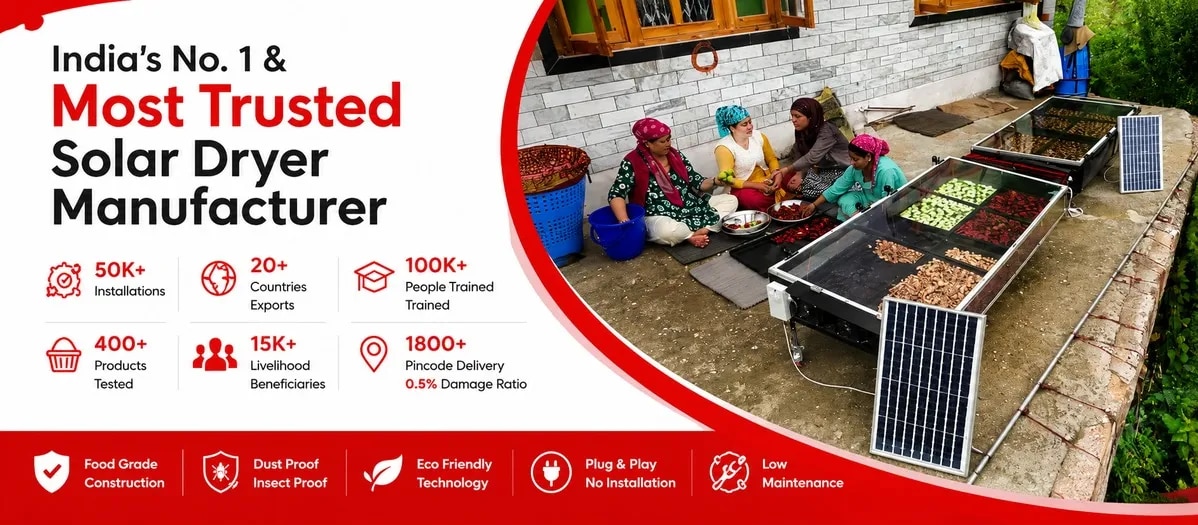
Rudra Solar Energy offers several solar dryer configurations and describes applications across agriculture and food processing. Its range includes cabinet dryers, fruit and vegetable dryers, spice and herb dryers, grain and pulse dryers, seed and oilseed dryers and larger commercial systems.
Why Solar Drying Is Relevant to Modern Agriculture
Agricultural businesses increasingly need to think about processing as well as production. Fresh produce can have a limited handling window, while dried products can provide another format for suitable commodities.Solar drying can become part of that processing strategy.
From Commodity to Processed Product
The process may involve:- Harvesting
- Sorting
- Cleaning
- Preparation
- Drying
- Cooling
- Packaging
- Distribution
The quality of every stage influences the final product.
Understanding Solar Drying Equipment
A modern solar dryer generally combines solar heat with airflow inside an enclosed chamber. Rudra Solar Energy describes its cabinet dryer as a tray-based system using direct and indirect solar heating and organised airflow. :contentReference[oaicite:89]index=89Why Airflow Cannot Be Ignored
When moisture leaves a product, the surrounding air becomes humid. Air movement helps carry that moisture away.This is why loading, tray spacing and airflow need to be considered together.
Application Specific Equipment
The product range includes dedicated dryers for several categories. Rudra lists solar fruit dryers, vegetable dryers, spice dryers, herb dryers, fish dryers, grain dryers, flower dryers, oilseed dryers, pulse dryers and seed dryers. :contentReference[oaicite:90]index=90Benefits of Product Focus
A product-focused system can be evaluated around the characteristics of the intended material rather than assuming one generic drying method works for everything.Businesses should still confirm technical suitability for their specific product.
Capacity Options
Rudra Solar Energy states that its cabinet solar dryer configurations range from 5 kg per batch to 500 kg per batch. :contentReference[oaicite:91]index=91This allows different users to consider different processing scales.
Small Enterprises
Small businesses may require Solar Dehydrator Machine compact systems for limited production or product development.Growing Businesses
A growing processor may require a larger batch configuration as raw-material availability increases.Commercial Operations
Large processors can evaluate higher-capacity cabinet or tunnel configurations.Product Quality Considerations
Drying conditions can influence the finished product. Rudra Solar Energy notes that commodity, initial moisture, preparation, slice thickness, loading, airflow, humidity, solar radiation and final moisture requirements can affect performance. :contentReference[oaicite:92]index=92Operators should therefore establish appropriate product-specific procedures.
Choosing a Solar Dryer Supplier
A buyer should evaluate more than the machine name.Questions can include:
- What products has the system been designed for?
- What batch capacity is available?
- How is airflow managed?
- What construction materials are used?
- What backup options are available?
- What installation requirements apply?
- What maintenance is required?
- What support is available?
Rudra Solar Energy provides product information and location guidance for evaluating suitable configurations.
Solar Drying as a Business Tool
A dryer should be viewed as part of a business process rather than an isolated machine.The business needs a raw-material supply, a product specification, packaging, storage and a route to market.
Economic Evaluation
The financial outcome depends on actual operating conditions. Businesses should estimate equipment cost, installation, labour, packaging, maintenance and Know More expected product sales.No particular income or return should be assumed without a project-specific calculation.
Conclusion
Modern solar drying equipment combines solar thermal energy with organised product handling to provide an alternative to open-sun drying and some conventional thermal processes.Rudra Solar Energy offers multiple solar Solar Dryer In India dryer types and capacity configurations for agricultural and food-processing applications.
The most important principle is matching the technology to the product and workflow. A successful drying operation requires suitable raw material, appropriate preparation, correct loading, airflow, monitoring, hygiene, packaging and storage. When these factors are addressed together, solar drying can become a practical processing tool for farmers, entrepreneurs, FPOs, SHGs and commercial food businesses.